


The Journey of Self-Leadership – Episode 1 of The Leadership Exchange Series – Priority Traffic Podcast
“Nothing so conclusively proves a man’s ability to lead others as what he does from day to day to lead himself”
(American Druggist, 1939)
— Thomas J. Watson

Several months back, I was asked to submit a piece on leadership for O2X, a human performance company I am an instructor for. At the time, I wasn’t as well-versed in the topic as I am today, thanks to this course. So, I sat down with a keyboard and a mind full of ideas and got to work. After racking my mind, I couldn’t find a great place to start. So I took some time off and that’s when I remembered a mantra of mine: “If you want to change the world, start with yourself, and if you want to change the future, start now.” This little nugget has slowly become a part of who I am and a core belief that I often share. That was my aha moment. Reflecting on that core belief, I was able to see that leading oneself seemed like the obvious place to set up basecamp as I began to ascend the mountain that is leadership.
The Importance of Self-Leadership
Understanding and embracing self-leadership, as a concept, is essential to all leaders, and rather straightforward: lead yourself before you try to lead others. According to a study by Chai et al. (2021), self-leadership is the waypoint where work performance is cultivated, well-being is nurtured, and personal development begins to bloom. John C. Maxwell, in his book The Self-Aware Leader, suggests that one of the biggest challenges leaders face is leading themselves. Maxwell suggests that leaders from the past, like Mahatma Gandhi, George Washington, and even King David, who are known for their leadership success, have also documented accounts of struggling to lead themselves at times (Maxwell, 2023). For me, leading myself has always been an uphill battle—but it’s about who you become on the way to the summit, not just the view from the top.
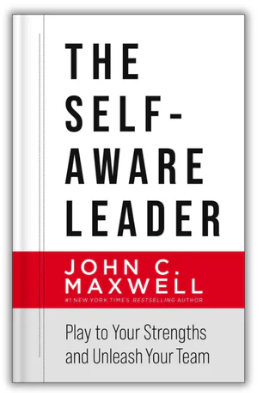
What’s the single greatest obstacle leaders face in their development, effectiveness, and advancement? Lack of self-awareness! Dr. John C. Maxwell’s The Self-Aware Leader will help any leader become more self-aware, focused, and confident. In this short yet insightful volume, you will learn how to:
- gauge your effectiveness as a leader,
- make better choices that lead to success,
- discover and correct your own mistakes,
- improve your leadership with the team, and make the right trades in your career.
Leading By Example
Self-leadership is essential to becoming a successful leader in any realm of life, whether in business, sport, personal, or transformative relationships. Leading oneself is the truest form of leading by example. When leaders walk the walk and lead with behavior and not just words, they are seen and perceived as a congruent entity, which creates space for integrity and trust. Not only does this create a sense of confidence amongst followers, but it also shows them how to be and really sets the tone for interpersonal behavior.

Benefits of Self-Leadership
According to the Indeed Editorial Team, self-leadership is crucial in achieving personal and professional growth. They provide several benefits of self-leadership:
- Makes you more efficient and productive
- Keeps you motivated and accountable
- Builds stronger relationships with co-workers
- Inspires others to follow your lead (Indeed Editorial Team, 2025, pp. 4)
As we embark on the journey towards self-leadership—which most of us already have, though we might not even know it—we start learning deeper truths about ourselves, turning inward, and sifting through what is ours and what isn’t. This is where the self-development journey starts to unfold and the magic happens, well, at least for me, it did. When we set our sights on the peak of a mountain, we have no choice but to start right where we are. For some, that’s at a metaphorical basecamp, equipped with the tools, insights, and experiences from previous “climbs.” For others, it can be far away, like when we are driving down a highway, longing for more in life, gazing at mountains in the distance, dreaming of something more.

Cultivating Self-Awareness
When we look inside ourselves, we are effectively cultivating one of the greatest skill sets we could ever have—self-awareness. With self-awareness, we are simply finding ways to get out of our own way, says Maxwell (2023) in his book The Self-Aware Leader. Maxwell posits that when we explore and construct our self-awareness, we begin to learn about how we function in the world and can be better leaders for others when we know how to lead ourselves. He recommends that we learn several concepts: the art of followership, cultivating and implementing discipline, improving our capacity for patience, and seeking accountability in all things. These four concepts give us a tremendous amount of authority in our own lives.

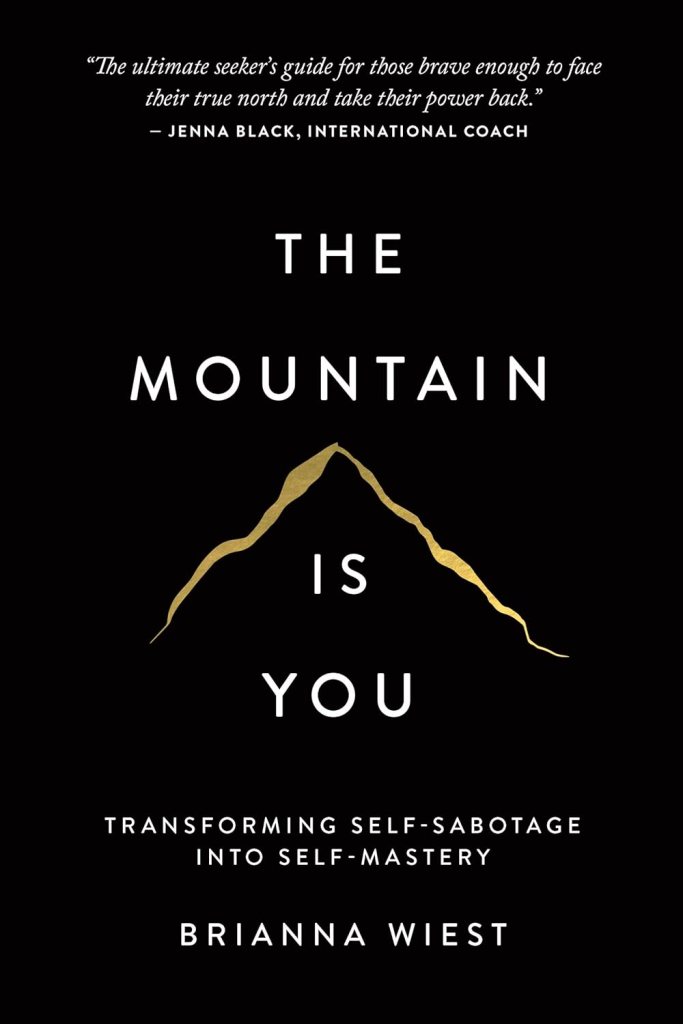
This is a book about self-sabotage. Why we do it, when we do it, and how to stop doing it—for good. Coexisting but conflicting needs create self-sabotaging behaviors. This is why we resist efforts to change, often until they feel completely futile. But by extracting crucial insight from our most damaging habits, building emotional intelligence by better understanding our brains and bodies, releasing past experiences at a cellular level, and learning to act as our highest potential future selves, we can step out of our own way and into our potential.
Authentic Leadership
Additionally, Northouse (2022) cites Shamir and Eilam (2005) suggesting that when leaders are capable of leading from an authentic place—where their leadership is genuine, and their motives and convictions are pure—they are experienced again more congruently. When a leader’s experiences are meaningful to them and integrated, they become more capable of being authentic, true-to-self leaders—genuine self-leaders.
Lead Yourself First
By adopting a “lead yourself first” mindset, we, the leaders of our world, begin to show up in a way that demonstrates we have plans, goals, and intentions. It shows that we act, are guided by principles, and hold our values sacred. When we lead ourselves first, we naturally start to influence those around us. Before too long, people around us begin to take cues from us and start to lead themselves. To me, this is the true act of leadership – where followers just start following, purely because of how you show up day after day. This is how we change the world.

How do you approach your self-leadership?
Remember – when YOU prioritize your wellness, you can achieve performance!
Your friend, Chris.
This was written initially a discussion board post for school, written by me, Chris, was posted there and then used in this fashion as a blog, written by Me, Chris Warden.
References
American Druggist. (1939). Nothing so conclusively proves a man’s ability to lead others as what he does from day to day to lead himself (Vol. 100).
Chai, W. Y., Shek, D. T. L., & Dou, D. (2021). Self-leadership in the service leadership theory. International Journal of Child Health & Human Development, 14(4), 437–447.
Indeed Editorial Team. (2025, January 29). What is self-leadership? 9 steps to develop your potential. Indeed Career Guide. https://www.indeed.com/career-advice/career-development/self-leadership
Northouse, P. G. (2022). Leadership: Theory and practice (9th ed.). SAGE Publications, Inc. (US). https://purdueuniversityglobal.vitalsource.com/books/9781071834473.
Maxwell, J. C. (2023). The self-aware leader. HarperCollins Leadership.
 High-Performance Wellness Solutions
Leave a comment